This piece originally appeared in United We Stand in 2021.
A young child’s head nestles into the lap of his father, who covers it with a blue jacket of the Colombian national team. The sun is beaming down on a typical Sunday in Soacha, a district almost overlapping Colombia’s capital, Bogotá.
The child is snoozing rather than watching right now but it is a familiar sight – apart from my presence in goal. Nine women, and me, are playing in a five-a-side cage in the shadow of hundreds of ‘illegal’ homes. This is an area of Colombia where more than 50% of the residents are domestic immigrants, displaced by La Violencia in Colombia and the guerilla control of the countryside. Many come with stories of pillaging, rape and death.
Soacha’s background is one of protracted violence, caused by the decades-long wilful ignorance of government, widespread poverty, and constant population growth, creeping up the mountainsides which can turn to sludge in rain. The area drew fame when presidential candidate Luis Carlos Galán was assassinated there in 1989. In the same year, Pablo Escobar bombed Avianca Flight 203 over Soacha. The local community is one of support and family but when the sky turns to dusk, and often before, everyone is aware of the threat of crime.
“You don’t live here, you survive,”
One charity supported by Manchester United midfielder Juan Mata’s Common Goal movement has revolutionised the fortunes of the community. More than 2000 children benefit from the brilliant work of Tiempo de Juego, a charity founded 15 years ago to fight for peace and equality.
“You don’t live here, you survive,” one Bogotáno explains about some of the city’s most deprived ‘barrios’. In Cazuca, Soacha, that’s not the case anymore. Almost every day, men and women of all ages don the custom made shirts of Tiempo de Juego, printed by the foundation in a small upstairs workshop. Orange, black and white ‘camisetas’ are integrated into a sea of European football shirts, mainly those of Real Madrid and Barcelona. The only United shirts on show are those from the 2014/15 season, the time of Radamel Falcao.
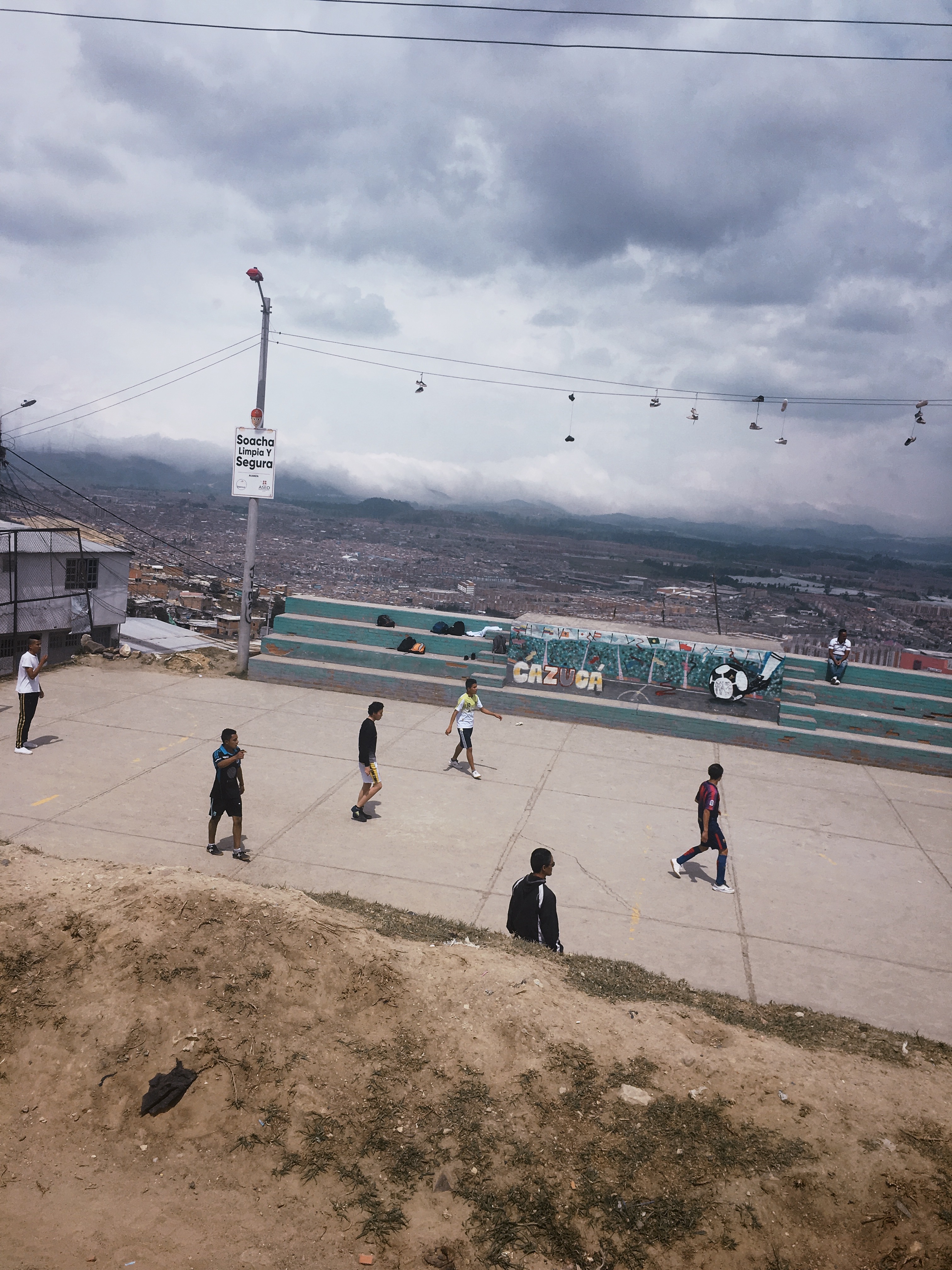
Every Saturday morning, Tibanica becomes a sporting hub. An athletics team constantly orbits this nucleus of sporting action: three football zones, a basketball court, two tennis courts. A small section on the far side is taken up by parents, working on their own fitness or in a classroom, learning about gender equality, safety and more.
One football session with a mixed gender team is particularly interesting. The players range from 14 to 17 in age. A pre-session game of crossbar challenge is concluded and 15 players spread out on the perimeter of the centre circle. This is not school, but they have been set homework and it’s not to practice their stepovers, but rather to think of one word to sum up the opposite gender. Some have done it, some have not. Women are described as ‘fuerte’ (strong) by some, but one player suggests that a woman’s main role is to be a companion to a man, whether as a mother, sister or partner. And as this isn’t school, he’s not reprimanded. But 20 minutes later, when the discussion has reached its end, the coach turns to him.
“Do you understand now?”
And yes, he does. Training in football’s typical sense of the word has yet to begin. But this discussion will be more impactful than any of the drills that follow over the next two-and-a-half hours under a piercing sun.
One of Tiempo de Juego’s earliest members, William Martinez, tells me that, in short, the foundation is about “empowering the local community via the game.” This is just one of many steps towards that each week.
The child watching his mother take part in a solely female (except me) five-a-side game, cheered on by husbands and sons, will grow up with a different, improved attitude to many other Colombians.
His mother and I are playing on a synthetic football pitch funded by various sponsors. Elsewhere in Soacha, investment is not quite so large although Tiempo de Juego’s presence in Cazuca has encouraged other non-governmental organisations, mainly Catholic charities, to enter the neighbourhood and offer support. In the past, the presence of banditas would have put them off.
“These people don’t exist to the government,”
In Ciudadela Sucre, another area in Soacha, the situation is direr. I’m taken there by the girl I’m staying with, Maleja, an organiser for the charity who studies at university in Bogotá. We board a small minibus for a short but bouncy journey up the road that connects Ciudadela Sucre to slightly more affluent areas. Houses are shacks, many without a front or a roof, and they are made out of whatever material was available when these families arrived from the Colombian countryside.
“These people don’t exist to the government,” Maleja explains. While the one winding road is solid and well-maintained for the most part, its tributaries are nothing more than a collection of stones carved out by streams of warm rain and dog shit.
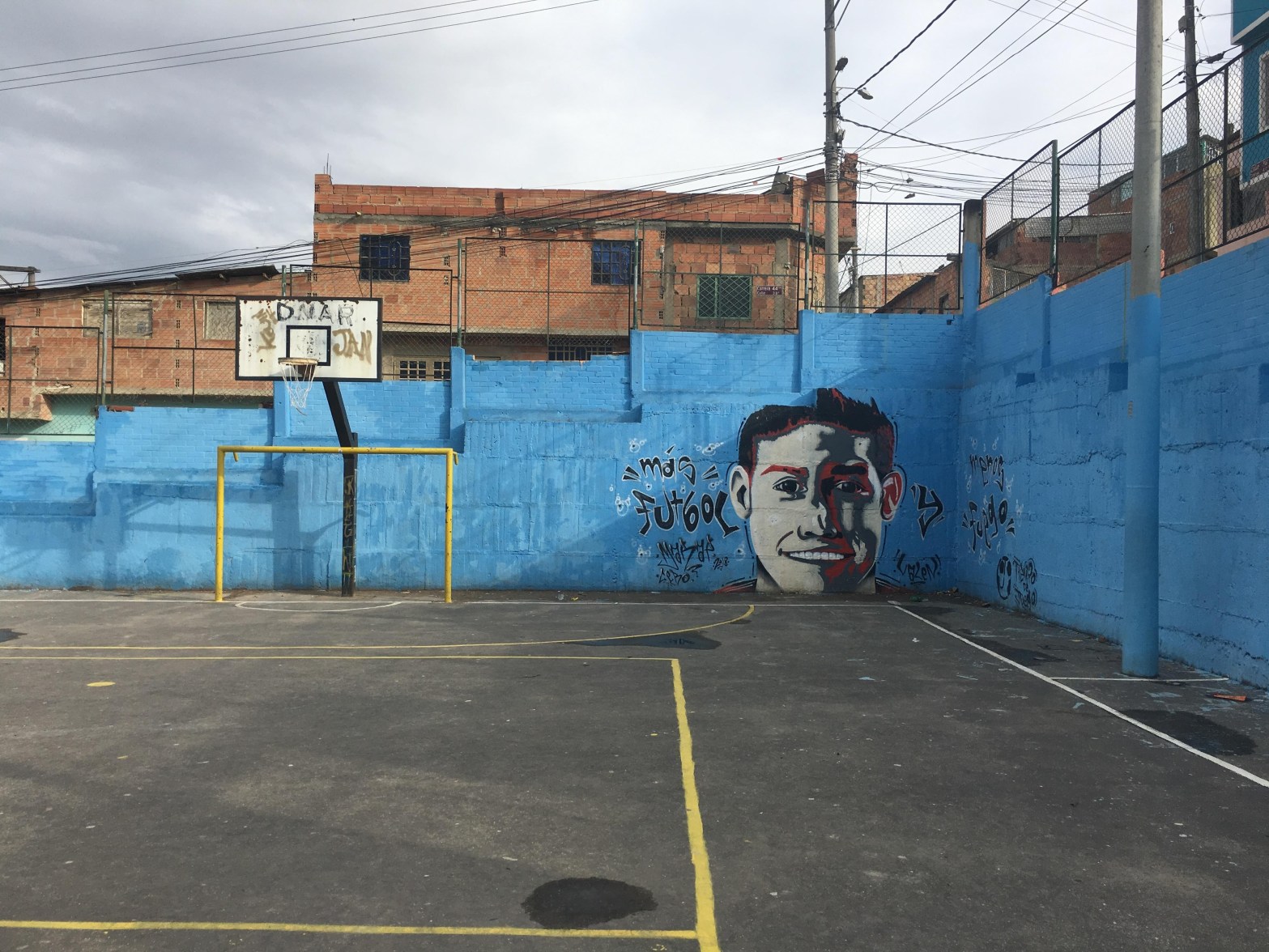
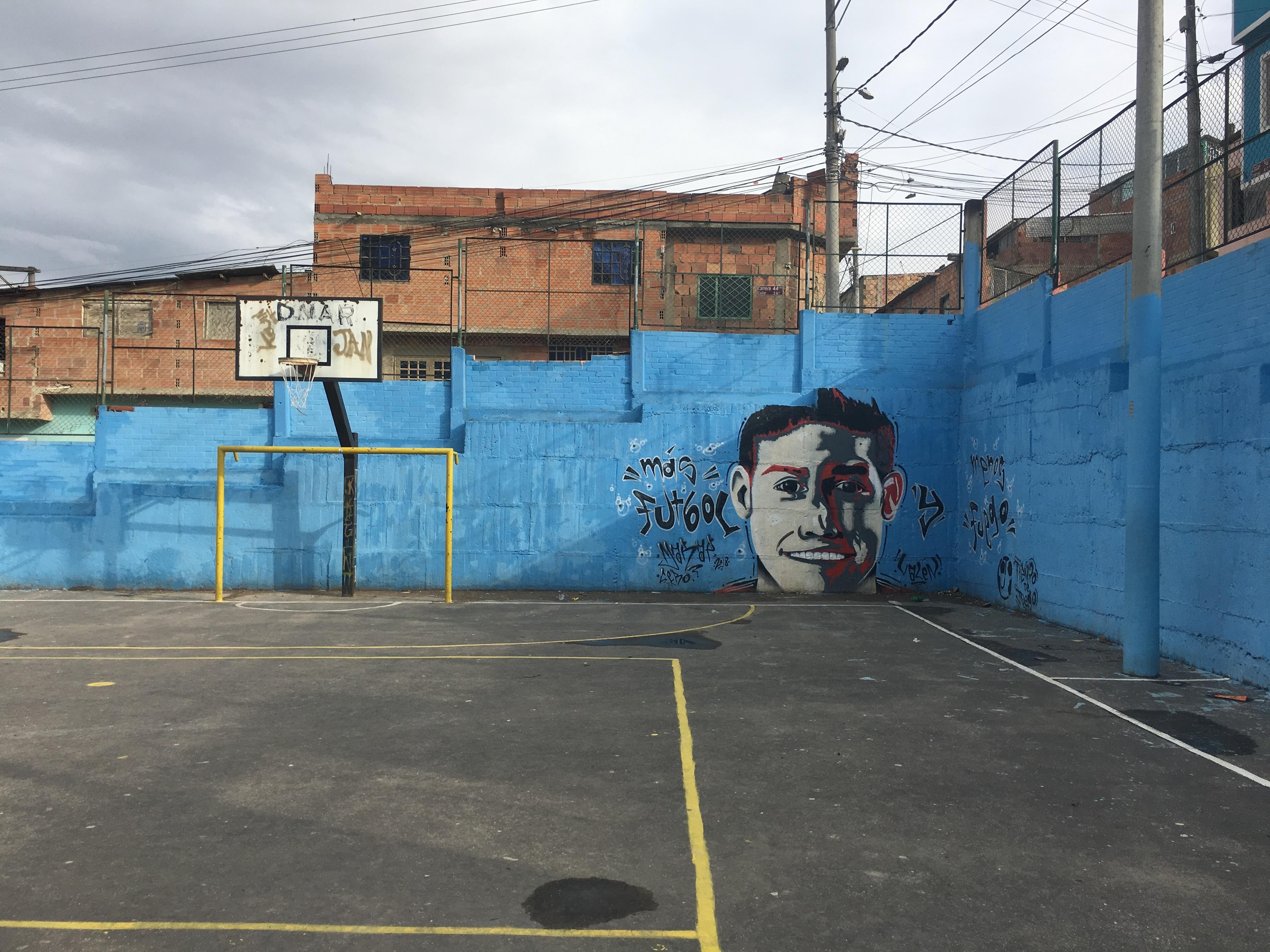
A short walk from where we get off is a pitch, one wall has the face of James Rodriguez graffiti-d onto it. 25 kids are excited to see us. We’ve brought bread and juice, prepared in the Tiempo de Juego bakery in Cazuca. It’s in that bakery where I have lunch a few times in the week. Colombians have a soup not dissimilar from Irish Stew; brothy, potatoey, a bit short on meat, comforting. The bakery is staffed by mothers of the kids who train with TdJ. Investment from VISA helped in this regard although most of it was spent training 40 locals to build and use urban gardens for cooking. One balcony is home to six metal barrels in which food grows.
Back up in Ciudadela Sucre, we do a couple of drills, play a frenetic match in which I try, and mainly fail, to nutmeg 8-year-olds. We head further up the hill and over its brow. On this side, there are no houses but instead dark green hills littered with cattle. 20 kids are brushing water off a grey pitch. They stop to have some juice we’ve brought and then carry on playing. One kid plays a ball across his own goal, it sinks in a puddle and the Ruud van Nistelrooy of the group nips in to tuck it home. Lesson learnt.
I interviewed William Martinez while sat in the bakery. He shouted into the kitchen to get me some soup and then tells me the story of a kid he calls paisa (someone from Medellin).
“Una historia locura,” he says. A kid seriously involved with a drug gang who never wanted to get involved with Tiempo de Juego. When he finally did, they realised he had a natural ability to lead. Years later, he started coaching with the foundation himself and with that experience, he went to university. He wants to move to Europe one day but, for now, he’s in Colombia, helping with the charity and wants to be a professional football coach. “We are sure he will do it,” William says proudly.
Another success story follows. William checks his phone to confirm. “Ivan,” he says, a kid who never liked sport and drank cerveza too often. “Today, he’s running in Uruguay. He’s representing Colombia in Uruguay.”
There are other stories. A couple of kids went to Russia for the World Cup while others enjoy dance, art, music and even journalism. Downstairs, beneath the bakery, is a Samsung-funded music studio, a small area to practice dance and four computers.
When one kid went to prison while a part of TdJ, he saw his sentence reduced because of the good work he’d done with the foundation. He’s since spent time going into prisons to teach coexistence and peace between gangs.
The stories of hardship aren’t unique to Colombia or even South America. Soacha is a place with a past like many others. In the 1990s, some towns in the area were welcoming 50 new families every day, fleeing from violence in the countrysides. They have no paperwork and they illegally built their homes. Tangles of wires shoot up the hill providing illegal electricity. Many choose to never complete paperwork in fear of the military groups who forced them out of their original homes tracking them down. There is a divide between those who are poor but have a decent flat, electricity and water, and those who don’t.
Before he founded Tiempo de Juego, Andrés Wiesner spent three years studying the area of Cazuca. He found a place where all of the country’s ills had come together at once.
Tiempo de Juego isn’t necessarily a unique charity. It’s one of thousands around the world using football as the excuse for improvement. But a marker of success is the creation of a community that a Manchester United player could come and visit. That’s what Juan Mata did.

“Common Goal,” William Martinez beams, “he [Mata] made that decision without any pressure. It’s so cool.”
“For a player of that level and status to take the time of day to come and see us, but, more importantly, to get to know us… it’s fantastic.”
“I was watching him play with the kids and thinking on the side, we’re going to injure Juan Mata! There were 300 kids. For them it’s more about the motivation it gives than the financial support he gives us. It’s knowing that he came to see them and he thinks about them. It’s so important.”
I tell him I’m a United fan and ask if Mata coming here has made everyone United fans too. He laughs. “We don’t know who has the most fans, Real Madrid because of James or Manchester United because of Juan Mata. Juan Mata is not a Colombian player but the kids feel very close to him, like he is one of their own.”
 HARRY ROBINSON